May 30, 2017

Yeghegnadzor and mountain lingerie

I enjoyed walking down from Noravank through the impressive canyon that is also a climbing paradise.
Some information.
The lower part of the canyon.
Also in the lower part of the canyon.

For the last kilometers I was picked up by a car of local people. They connected me with the gentle local people in the restaurant at the crossing with the highway. There they helped me to travel further. It was complicated to find a kind of a taxi but they phoned around. After a nice hour watching a Russian TV show and drinking tea they organized a driver who was willing to drive me to Yeghegnadzor not further to the south. So the stop in Yeghegnadzor was not planned. But well, I love these unforeseen situation because these are the moments to learn about a country.

While driving through to the scenic valley of the Arpa river the
Jaan Kuman Instrumental Ensemble
is a good choice to listen to.

Yeghegnadzor is a small town and I noticed immediately that something is wrong with it. It was so quiet. The stores were open but there were almost no customers. In the hotel I talked with the young english-speaking staff and what they told me explained the situation: People live close to poverty but more important is that they don't have a perspective. Most of the men are working abroad in Russia. Only because of their money the woman and children who stay in Armenia can survive. They were very unhappy about this. The families are not united and the work life in Russia seem to be hard. There was the fear that Russia could send their men back to protect their job market and people also feared the high corruption in Armenia. All talks were therefore quite depressing. I cannot describe it properly with words but even before I could talk I got the blues of the locals just by walking around. Once more it corroborated that it is not that hard to live a simple live but to have no perspective. It was sad to see that the people in Armenia's south didn't have one.

Hotel Arpa, where I stayed. A nice one but without
other guests that time.
This building besides the hotel was used as youth club.
There was a small party going on that evening.

View down the Mikoyan street. By the way, Anastas Mikoyan was
for one year the nominal head of the Soviet union while his brother
Artem was the famous aircraft designer.
The town is surrounded by high mountains.


The bank buildings in Armenia were always either new
or perfectly renovated.
A new school or university building (I think).
 
This is the junction with the highway. Note the traffic enforcement
camera on the right side. The road is so bad that I wonder how one can
drive too fast. Note also that this is the main road connecting the south
of the country with the rest. Incredible that it is in such a state!
View from the highway junction to the town.


Leaving the town the next day was not easily possible because of the problematic of the buses I described. In the hotel they had an illustrated book with pictures of the surrounding. So why not visit one of the places in the book? I asked the lady at the reception how to go to Smataberd to see also another sight than only churches. She organized not a taxi but her boyfriend that he could also earn some money. We drove up a narrow road with his old Lada. Although that Smataberd is only 20 km from Yeghegnadzor he had never been there. He insisted to climb with me up to the fortress but had to give up after a few hundred meters because he had only normal street shoes and the ground was wet and hard to walk on. With good shoes climbing up is not difficult and the view from the top is fantastic.

This deserves another song: Gramatik - A Bright Day

The houses in the valley around Shatin.
This explains why street shoes were unsuitable.
It is also an option to visit the Tsakhats Kar monastery too.

The weather was so amazing. It changed quickly and one could see the full beauty of the mountains only for some moments. Like lingerie makes a woman more attractive: You cannot see all but enough to play cinema in your head.

View to the north.
View down to Artabuynk.
Nature was awaking, also the spiders.
Very close to the fortress but it is still hidden.
And here it is.


The entrance with some information,...
... even in English.
Closeup of the entrance.
The clouds were moving so fast that the scenery looked different every minute.


The sun that passed the clouds also changed the color of the light...
 

... This image was only taken about a minute after the one on the left side.

May 28, 2017

The Noravank monastery

We reached Noravank in the afternoon with beautiful weather (that in general often changed quickly in the mountains). This monastery is really worth a visit. It was rebuilt in the 1990s with the help of a patron, an Armenian living abroad. The nice thing is that it contains a good museum that even has English information plates and where one can ask people to learn about the interesting culture and history.

While admiring the landscape and architecture you might listen to Get Well Soon - When you're near to me.

The Surb Astvatsatsin church was designed by a monk who dies before it could be finished. His ideas were nevertheless used. The most famous one is the stair forming the elevated entrance of the church.

The Surb Astvatsatsin church. The main entrance is the upper door.
The stairs don't have a railing but that's not the problem.
I just stood on the first step of the stair so that my shoulder touched the wall.


The other side frightened me even more.

 
Some tourists in a hurry - they came, took a photo of the church, went up,
took a photo inside, went down and walked away. As this is a standard stairs.

I was embarrassed by the others who could use the stairs while I couldn't. In the museum they said that the reason for the stairs are that people often brought animals to the church service and that should be avoided. Also the person going to the church service should trust in god. "If one trusts god one is safe on all his ways."
If there is a god he made me, right? He made me with fear of heights an prevented to enter his church. So either he made me wrong but a god doesn't make mistakes or the monk misunderstood god's will despite he was praying several times a day. OK, I stop questioning. I cannot trust in a god because all religions tell that their god(s) is(are) the only one(s) and their way of praising him(them) is the correct one. That simply doesn't make sense.

View from the monastery complex down to the valley.

The Surb Astvatsatsin in front and the Surb Karapet
church in the background.

The lower level of the Surb Astvatsatsin church
has less ornaments and only small windows without glass.
The inside is quite "naked" as most of the Armenian
churches. Here I wondered why there is no even floor.

The Surb Karapet church.
The side door of the Surb Karapet is a khachkar.

The Surb Karapet church is more interesting because of its interior. It contains in a side building also a mausoleum of a prince.

The main entrance.
The left door is the entrance of the mausoleum.
The church has a stone floor in which there are tombstones.
Interesting ceiling.


The interior is a bit unusual because the altar is upstairs in a small room.


The architecture of the window is strange. As if something went wrong during the building. The decided not to use a bow for the window ceiling and that made obviously problems.
The mountains are impressive.
They rebuilt also some of the small houses where the monks lived.

As I wrote the museum is great. I learned for example about the Holy Chrism and how it is made. The many different ingredients are put together using a recipe that is only known by the Catholicos. He cooks the Chrism together with some bishops. The whole creation process takes several days.

The (known) ingredients of the Holy Chrism.

Such cups in form of a bird are used to serve the chrism
during church service.
An original bible written and pained by
the monk who planned the Surb Astvatsatsin church.
A lamp.
 
The ingredients used for the colors of the
paintings in the bible and on ceramics.
The Armenian alphabet painted with these colors.

The museum also presents some khachkars  and some images about the history of the complex, the archeologic excavations and the rebuilding.

The khachkar exhibition and the museum building.
 
The left image shows the Surb Astvatsatsin church before 1940, the right one the result of the preservation in the 1980s

The gentle driver and his daughter could not understand that I wanted to stay longer than 15 minutes in Noravank. She said it was her first time in Noravank nevertheless they went straight to both churches, lighted candles and drove away.
Everywhere where I have been most people don't care about architecture and history. Also many religious people just go to curch because for church service but don't know much about the church building etc.. And as I mentioned in an older post Armenia is not a very religious country.

In fact is was a good decision to stay there longer. As consequence I had to walk down because there are no public buses to/from Noravank. The tourist buses don't transport other persons than the ones who booked e.g. a touristic day trip. I cannot recommend such a trip because the tourists only had half an hour for the whole complex. This is much too short. If you go there you will need 1 to 2 hours.

The weather can change quickly in the high mountains. And within 5 minutes the sun was gone and it rained.

May 25, 2017

On the road to the South of Armenia

I had not much time and I wanted to learn about the country. The capital of a country is often a bubble. So it was time to leave Yerevan.

At first some popular music of 2015:  Romik Avetisyan & KARENCHIK - Сводишь с ума
After the interesting music I heard in Georgia, the Armenian music I heard was disappointing. Either it was this kind of pop or they played songs from the Soviet times.

Getting information how to travel, when and for what price was hard to get. As I wrote there is no tourist information and only few people can understand English. Fortunately I met the owner of the hotel Villa Rosa. It was not easy to communicate because of his English but when you want to, there is always a way! We had a great time and I learned a lot from him about the Soviet time and how he made it from a chemist to a salesman of ArArAt (Armenian cognac). I told him about my plans and he guided me to the a bus station that I would never have found alone. He explained the bus driver where to let me out and the adventure began.

View from the hotel to the new buildings in the neighborhood of Kond.
Kond is one of the few quarters left with small houses. It seemed as if most of the quarter will be rebuild.

The bus left the city passing the airport. Everything looks normal until the airport but then suddenly everything changed: Bad roads, ruined houses, no gardens but dusty places all around. I was a bit shocked of how abandoned the countryside is.

The first stop was the monastery Khor Virap. The found of the Armenian Church, Gregory the Illuminator, was imprisoned in the city of Artaxata for many years. The monastery was built centuries later at the citadel of the extinct Artaxata.

The buses just drive along the highway. There is no stop at the crossing to Khor Virap, except that you explicitly ask for. From the highway to the monastery is no public transport. In the summer months some private taxis are around offering to drive you the about 3 kilometers. I had to walk but that was OK. I was lucky because just when I arrived a military ceremony ended. During the ceremony the whole complex was blocked. The monastery itself is not very special. There is nothing interesting to see and except of the plates for blind people sponsored by USAID there is no information. Very disappointing for one of the most famous tourist sites of a country. the view however is beautiful as you can see in the pictures. Unfortunately one could not see the Ararat despite its peak is only 20 kilometers away.

The monastery complex. In the background you can see
the border to Turkey that is closed now for almost 100 years. Incredible!
Only between 1953 and 1993 there was a single crossing point to Turkey
close to the city of Gyumri.
View from the entrance of the monastery
over the place of the former Artaxata. Note
that the military people were carried there by
the civil buses you see.

The curch.
The only information for tourists in the monastery. Yes, that is only Braille.


The crossing of the highway with the street to Khor Virap.
There is no bus stop, nor a route sign. The bikers are brave.
I cannot recommend cycling there because the drivers are often reckless.
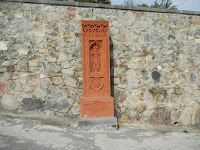
A Khachkar on the way up the the entrance of the monastery.

Khow Virap was the first time that I noticed the Khachkars. These stones showing a cross are scattered all over the country and are important for the Armenians and their culture. The neighbors of Armenia are aware of the importance and many times in history Khachkars were destroyed purposely, see e.g. the Armenian cemetery in Julfa.

I stood on the highway crossing for a long time but all the buses that passed me were full. Some days later I realized the strange transport system of Armenia:
All buses start in Yerevan and drive to a certain destination. They wait until the bus is full before they start. Getting off at intermediate stops is not planned. Of course one can ask the driver but has to pay in most cases nevertheless the full price to the destination of the bus. Therefore usually nobody gets off before the destination of the bus and therefore the buses are full the whole time. Young soldiers who could speak English told me that the best is to get back the Yerevan and then take a bus to my next stop, then get back again to Yerevan and so on. Absolutely crazy bat as I experienced, that was the truth. it is hard to realize that indeed Armenians living e.g. in Vayk cannot just take a bus to e.g. Goris. All the buses bass the villages but don't stop. And if they do in the rare case there is a free seat you have to pay a high price. It is strange that the politicians don't realize that this blocks the development of the country. Affordable transport is a very basic thing that is available in all countries I have been so far. But as you will see in the next posts the politicians don't care in general about the countryside.

If you are a nice looking girl you can of course hitch-hike from all places quickly. I had to wait quite long before I found ways to travel further. From Khor Virap a crazy men and his daughter picked me off. They both could not speak a single word English but he tried to pair me with his daughter anyway while she was so ashamed for her father. Thus we had some funny situations.

We drove a long way to the south and I could tell them that I want to see Noravank. In Yerash the highway ends because the border to Nakhchivan is closed. As also the railway is disconnected. The road gets up to a 1800 meters high mountain pass. The first kilometers of the road is close to the border and I noticed that the driver did not feel well to be so close to the border. There was also much construction work going on to fortify the border. On the way up one passes the former Azerbaijan enclave of Karki. Looking at the map one sees that the border lines once drawn by the Soviets provokes conflicts sooner or later: The village can only be reached by the main road that connects the north or Armenia with the south. The other 2 possible streets to reach southern Armenia cross either a 1900 m or even 2400 meter high pass. Of course one cannot prove this but I sure these strange borders were drawn purposely because the different soviet republics should not unite. Other examples of these kind of borders are the different enclaves of Uzbekistan, Tajikistan and Kyrgyzstan, e.g. Sokh.

To get an impression of the landscape.
In the former enclave. Very meager land.

We reached Noravank in the afternoon with beautiful weather (that in general often changed quickly in the mountains).